Knife Skills 101: Dice, Mince, Julienne, Chiffonade
At a Glance The four fundamental knife cuts—dice, mince, julienne, and chiffonade—form the foundation of efficient and consistent food preparation, ensuring uniform cooking and professional presentati…
The four fundamental knife cuts—dice, mince, julienne, and chiffonade—form the foundation of efficient and consistent food preparation, ensuring uniform cooking and professional presentation. Mastering the dice produces identical cubes for even heat distribution, mincing releases concentrated flavor from aromatics, julienne creates elegant matchsticks for salads and stir-fries, and chiffonade transforms leafy herbs into delicate ribbons. Practicing these techniques with a sharp knife and proper grip directly improves cooking speed, texture, and visual appeal across a wide range of dishes.
Getting your veggies and herbs cut just right makes a big difference in how your food looks and tastes. When you can chop, slice, and dice like a pro, your dishes go from good to great. It’s not just about making things pretty; it’s about cooking evenly and efficiently.
Learning Knife Skills 101: Dice, Mince, Julienne, Chiffonade helps you achieve that. You’ll learn to prepare ingredients faster and more accurately, making your time in the kitchen more enjoyable and your meals more delicious. Let’s get started on making your cooking shine.
Key Takeaways
- Understand the basic cuts: dice, mince, julienne, and chiffonade.
- Learn why proper knife skills improve cooking and presentation.
- Discover the right tools and how to handle them safely.
- Gain practical tips for practicing and mastering these fundamental techniques.
- See how different cuts affect cooking time and texture.

Why Basic Knife Cuts Matter for Better Cooking
When you’re cooking, the way you cut your ingredients can change everything. Think about a soup versus a salad. A soup might have larger chunks, while a salad needs delicate pieces.
This is where knowing your knife cuts comes in handy. Proper preparation means your food cooks evenly. It also makes your dishes look much more appealing.
Mastering Knife Skills 101: Dice, Mince, Julienne, Chiffonade isn’t just about looking fancy; it’s about making your food taste better and your cooking process smoother.
A well-executed cut ensures that every piece of an ingredient cooks at the same rate. This is especially important for vegetables. If you have some large pieces and some tiny pieces of onion in a stir-fry, the small bits will burn before the large ones are soft.
This leads to uneven textures and flavors. Learning these fundamental techniques helps you avoid common cooking pitfalls. It also boosts your confidence in the kitchen.
You’ll start to feel more comfortable tackling any recipe.
Beyond even cooking, presentation plays a big role in enjoying food. Think about a beautifully arranged salad or a perfectly plated main course. The neat, uniform cuts make the dish look professional and appetizing.
This is a skill you can build upon. As you get better at basic cuts, you can move to more complex techniques. But for now, let’s focus on the essentials of Knife Skills 101: Dice, Mince, Julienne, Chiffonade.
These are the building blocks for all great knife work.

The Essential Tools for Sharp Results
Before you start cutting, you need the right tools. The most important tool is, of course, a good knife. You don’t need a whole set of knives to start.
A chef’s knife is incredibly versatile. It’s good for chopping, slicing, and dicing. A smaller paring knife is useful for smaller tasks and more delicate work.
Make sure your knives are sharp. A dull knife is actually more dangerous than a sharp one. It can slip easily and cause injuries.
A sharp knife requires less force to cut. This means you have more control over your cuts. It also makes the process much faster and more enjoyable.
Keeping your knives sharp is a key part of knife safety. You should also have a stable cutting board. A wooden or plastic cutting board that doesn’t slide around is essential.
Place a damp paper towel or a non-slip mat under your cutting board to keep it from moving while you work. This adds another layer of safety.
Consider the type of cutting board you use. Wood boards are great for knives, as they are gentler on the blades. Plastic boards are easy to clean and sanitize.
For practicing Knife Skills 101: Dice, Mince, Julienne, Chiffonade, a good quality chef’s knife and a stable cutting board are your best friends. Always wash your knives by hand. Dishwashers can dull the blades and damage the handles.
Proper care ensures your tools last longer and perform better.

Mastering the Dice: Uniform Cubes for Every Dish
Dicing is a fundamental technique. It means cutting food into small, uniform cubes. This is perfect for mirepoix, which is the base for many sauces, soups, and stews.
Mirepoix is typically made of diced onions, carrots, and celery. The size of the dice can vary. Small dice are about 1/4 inch.
Medium dice are about 1/2 inch. Large dice are about 3/4 inch.
Here’s how to dice an onion:
- First, cut the onion in half from root to stem. Peel off the outer skin.
- Place one half flat on the cutting board, root side down.
- Make horizontal cuts into the onion, but don’t cut all the way through the root. The number of cuts depends on how small you want your dice.
- Next, make vertical cuts from the tip towards the root. Again, don’t cut through the root.
- Then, hold the top of the onion firmly and make vertical cuts across the previous cuts. This will create your dice. The root end holds the pieces together until the end.
- Finally, cut off the root end and dice any remaining pieces.
This method ensures you get uniform pieces. Uniformity is key to even cooking. When all your pieces are the same size, they will soften or brown at roughly the same rate.
This is a crucial part of Knife Skills 101: Dice, Mince, Julienne, Chiffonade. Practicing dicing with different vegetables like potatoes, carrots, and bell peppers will build your muscle memory. Start with larger dice if you’re a beginner and gradually work towards smaller, more precise cuts.

The Art of Mincing: Tiny Pieces for Big Flavor
Mincing is about cutting food into very, very small pieces. Think tiny. It’s smaller than dicing.
Mincing is often used for ingredients like garlic, ginger, and herbs. These ingredients release their flavor more readily when finely minced. This allows their taste to distribute evenly throughout a dish.
For example, minced garlic provides a potent, consistent flavor in sauces and marinades.
To mince garlic:
- First, peel a clove of garlic.
- Next, place the clove on your cutting board.
- Using your chef’s knife, chop the garlic roughly.
- Then, gather the chopped garlic into a small pile.
- Rock your knife back and forth over the pile, chopping repeatedly. Continue this until the garlic is a fine paste or very small pieces.
- You can also mince herbs like parsley or cilantro this way. Gather them into a ball and chop finely.
Mincing requires patience and a sharp knife. The goal is to break down the cell walls of the ingredient as much as possible. This releases more of its aromatic oils and flavors.
If you’re mincing herbs, it’s best to do it just before adding them to your dish. This preserves their fresh, vibrant taste. Learning this technique is essential for many cuisines, especially when developing complex flavor profiles.
It’s a key component of Knife Skills 101: Dice, Mince, Julienne, Chiffonade.

Julienne: Fine Matchsticks for Elegance
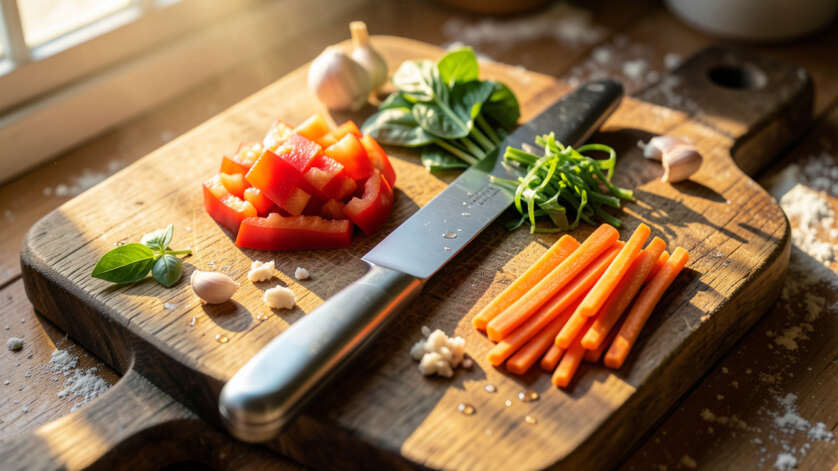
The julienne cut creates long, thin strips that resemble matchsticks. This cut is elegant and adds a refined texture to dishes. It’s often used for vegetables like carrots, zucchini, bell peppers, and potatoes.
It’s also great for garnishes. The uniform shape of julienned vegetables cooks quickly and evenly.
How to julienne a carrot:
- First, trim the ends of the carrot.
- Peel the carrot if desired.
- Cut the carrot into sections about 2-3 inches long.
- Next, cut each section into flat planks about 1/8 to 1/4 inch thick.
- Stack a few planks on top of each other.
- Then, cut the stacked planks lengthwise into strips of the same thickness as the planks. These are your julienned strips.
The key to a good julienne is consistency. All the strips should be roughly the same size. This ensures they cook uniformly.
Julienned vegetables are excellent in salads, stir-fries, or as a side dish. They also look beautiful when used as a garnish. For example, julienned bell peppers add color and a slight crunch to fajitas or tacos.
This technique is part of the essential Knife Skills 101: Dice, Mince, Julienne, Chiffonade repertoire.

Chiffonade: Silky Ribbons of Herbs and Greens
The chiffonade cut is used primarily for leafy greens and herbs. It involves stacking leaves and rolling them tightly, then slicing them into very fine ribbons. This technique is perfect for basil, spinach, lettuce, mint, and other tender greens.
The resulting ribbons are delicate and visually appealing.
To make a chiffonade of basil:
- First, wash and dry your basil leaves thoroughly.
- Stack several leaves on top of each other.
- Next, tightly roll the stacked leaves from one end to the other, creating a cigar shape.
- Hold the rolled leaves firmly on the cutting board.
- Then, use your sharp knife to slice across the roll. Make thin, even slices to create ribbons.
- Finally, gently separate the ribbons with your fingers.
This cut is ideal for garnishes or adding a fresh element to dishes just before serving. It’s particularly useful for herbs, as it releases their aroma without bruising them too much. A chiffonade of basil is beautiful sprinkled over pasta or pizza.
Spinach can be chiffonaded and wilted quickly into a sauce or soup. This technique really shows off the delicate nature of greens and herbs and is a vital part of Knife Skills 101: Dice, Mince, Julienne, Chiffonade. It’s a simple way to elevate the presentation of your food.

Putting It All Together: Practice Makes Perfect
Learning these knife cuts takes practice. Don’t get discouraged if your first attempts aren’t perfect. The most important thing is to be safe and patient.
Start with softer vegetables like zucchini or cucumber. Then move on to harder ones like carrots or potatoes. You can also practice with firm fruits like apples or pears.
Here are some tips for practicing:
- Start Slow: Focus on making clean, consistent cuts rather than speed.
- Use a Sharp Knife: As mentioned, a sharp knife is safer and more effective.
- Consistent Pressure: Apply steady pressure to cut through ingredients smoothly.
- Practice Regularly: The more you cut, the better you’ll become. Try to incorporate these cuts into your everyday cooking.
- Watch and Learn: Look at videos or demonstrations of the cuts. Seeing it done can be very helpful.
Remember that the goal of Knife Skills 101: Dice, Mince, Julienne, Chiffonade is to improve your cooking. As you become more comfortable, you’ll find yourself naturally reaching for the right cut for the right ingredient. You’ll also start to notice how different cuts affect the final dish.
This knowledge will make you a more intuitive and skilled cook.
Frequently Asked Questions
What is the most important knife skill to learn first?
The most important skill to learn first is how to hold your knife safely and how to make basic slicing and chopping motions. Mastering these fundamentals will make learning specific cuts like Knife Skills 101: Dice, Mince, Julienne, Chiffonade much easier and safer.
How do I keep my knives sharp?
To keep your knives sharp, use a honing steel regularly to realign the blade. For true sharpening, use a whetstone or have your knives professionally sharpened. Always wash knives by hand and store them properly to prevent damage.
Is it really important to cut vegetables uniformly?
Yes, it is very important. Uniform cuts ensure that all pieces of an ingredient cook at the same rate, leading to more evenly cooked food and better texture and flavor distribution. This is a core principle behind Knife Skills 101: Dice, Mince, Julienne, Chiffonade.
Can I use any knife for dicing and mincing?
While a chef’s knife is ideal for most dicing and mincing tasks due to its size and blade shape, you can use a smaller utility knife for smaller items or a paring knife for very delicate mincing. However, a sharp chef’s knife is the most versatile tool.
How long does it take to get good at knife skills?
Becoming proficient takes time and consistent practice. You can learn the basics of Knife Skills 101: Dice, Mince, Julienne, Chiffonade within a few sessions, but true mastery and speed develop over weeks and months of regular use in the kitchen.
What’s the difference between chopping and mincing?
Chopping typically results in larger, more irregular pieces, while mincing creates very fine, almost paste-like pieces. Mincing breaks down the ingredient more significantly to release more flavor and distribute it evenly.
Final Thoughts
Mastering Knife Skills 101: Dice, Mince, Julienne, Chiffonade can truly transform your cooking. By practicing these fundamental cuts, you ensure even cooking, improve presentation, and make your kitchen tasks more efficient. Keep your knives sharp, practice consistently, and enjoy the delicious results.