How To Choose The Right Pan Size For Your Stove
At a Glance Choosing the right pan size for your stove requires matching the pan diameter to the burner size to ensure even heat distribution and prevent burning or undercooking. For example, a 10-inc…
Choosing the right pan size for your stove requires matching the pan diameter to the burner size to ensure even heat distribution and prevent burning or undercooking. For example, a 10-inch skillet pairs well with a large burner, while a 6-inch saucepan suits a small burner, and larger families should opt for 12-inch pans for batch cooking. Selecting the correct pan size leads to more consistent cooking results and less wasted food, making every meal more efficient.
Picking the right size pan for your stove makes a big difference. Using a pan that’s too big or too small can mess up your cooking. It might burn your food, cook it unevenly, or just not work right.
Knowing How to Choose the Right Pan Size for Your Stove helps you get better results every time you cook. You’ll end up with perfectly cooked meals and less wasted food, making your time in the kitchen more enjoyable and successful. We’ll cover all the important things to think about so you can pick the best pan for any recipe.
Key Takeaways
- Matching pan size to burner size prevents uneven heating and burning.
- Larger families or batch cooking require bigger pans.
- Smaller pans are better for single servings or quick sautés.
- Pan material and shape also play a role in how well it fits and heats on your stove.
- Consider the type of cooking you do most often when selecting pan sizes.
- A well-chosen pan size leads to more consistent cooking and better food.

Why Pan Size Matters on Your Stove
It might seem simple, but the size of your pan really matters when you’re cooking on the stovetop. If your pan is much smaller than your burner, the heat will spread out too much. This means the edges of your pan won’t get hot enough, and your food won’t cook evenly.
On the other hand, if your pan is way too big for the burner, the heat will only hit the center. The outer parts of the pan will stay cool, leading to uneven cooking and potential burning in the middle while the edges are raw.
This is why learning How to Choose the Right Pan Size for Your Stove is so important. It’s not just about fitting the burner; it’s about making sure your food cooks how it’s supposed to. When the pan and burner are a good match, heat transfers efficiently.
This means your food cooks evenly, sears properly, and you avoid those frustrating hot spots or cold spots. Getting this right means better tasting meals and a smoother cooking experience.

Matching Pan Size to Burner Size
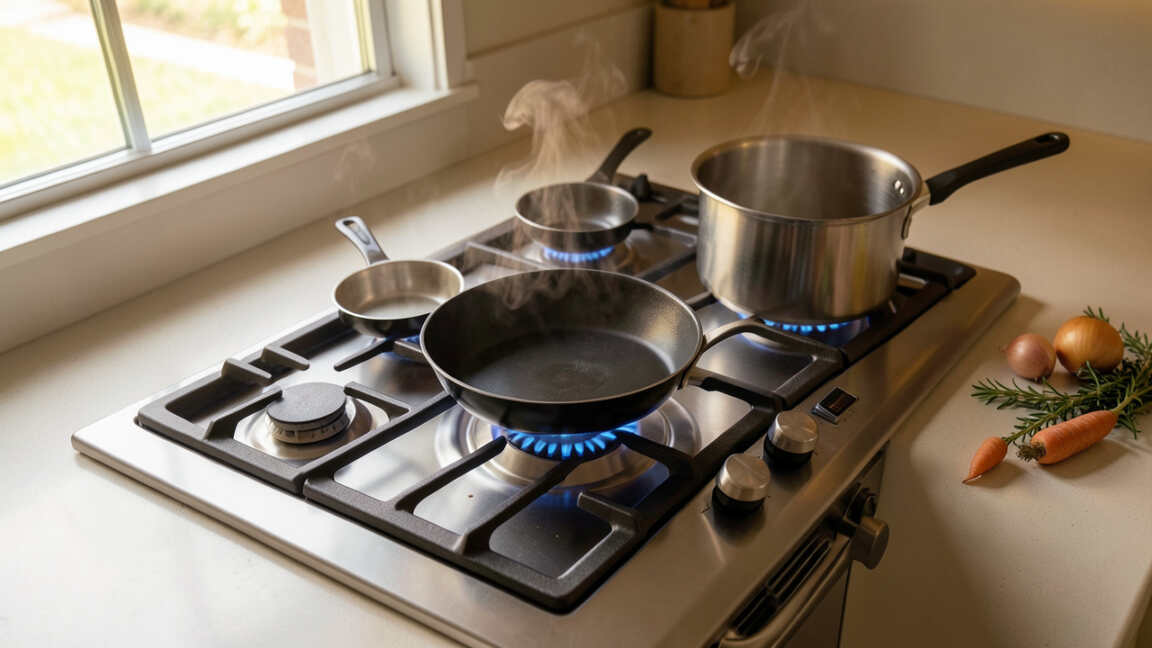
The most basic rule for How to Choose the Right Pan Size for Your Stove is to match the diameter of your pan to the diameter of your stovetop burner. Most stovetop burners have markings or are sized in inches. Look for a pan whose bottom diameter is very close to the size of the burner.
Ideally, the pan’s bottom should cover about 75% to 90% of the burner’s surface area. This ensures the heat is distributed effectively across the entire bottom of the pan.
If your pan is too small for the burner, heat will spill over the sides. This can damage your stovetop, waste energy, and cause uneven cooking. If your pan is too big, the burner won’t be able to heat the entire bottom evenly.
The center will get very hot, but the edges will remain cooler. This leads to food that’s burnt in the middle and undercooked on the outside.
For electric coil stoves, this matching is even more critical. The coils directly heat the pan. For gas stoves, the flames can lick up the sides of the pan.
While gas offers a bit more flexibility, an oversized pan can still lead to uneven heating and even burn the handle. A correctly sized pan ensures the heat stays where it should – on the cooking surface.

Considering Your Cooking Needs and Family Size
Beyond burner size, think about what you cook most often. Are you usually cooking for one or two people, or do you feed a large family? This is a key part of How to Choose the Right Pan Size for Your Stove.
For individuals or couples, smaller pans are often perfect. An 8-inch skillet is great for frying a single egg or sautéing a small portion of vegetables. A 10-inch skillet is a good all-around size for two people.
It can handle searing a couple of chicken breasts or making a side dish for two.
If you have a larger family or often cook for guests, you’ll need bigger pans. A 12-inch skillet is a workhorse for families of four or more. It can sear multiple pieces of meat, stir-fry a large batch of veggies, or make a big omelet.
Larger pots, like a 6-quart stockpot or larger, are essential for boiling pasta, making soup, or stew for a crowd.
Consider also if you do a lot of batch cooking or meal prepping. If you make large quantities of chili, pasta sauce, or stews to freeze, you’ll definitely need larger pots and pans. Don’t be afraid to have a variety of sizes in your kitchen.
The right size pan for the job makes cooking much easier and more efficient.
Common Pan Types and Their Ideal Sizes
Different types of pans have different uses, and their ideal sizes can vary. Understanding these differences helps you make better choices when learning How to Choose the Right Pan Size for Your Stove.
Skillets (Frying Pans)
Skillets are your go-to for searing, frying, and sautéing. Common sizes include 8-inch, 10-inch, and 12-inch.
- 8-inch skillet: Best for single servings, like one or two eggs, a single pancake, or small amounts of vegetables.
- 10-inch skillet: A versatile size for 2-3 people.
Good for cooking 2-3 chicken breasts, a side of vegetables, or a small stir-fry.
- 12-inch skillet: Ideal for families or cooking larger portions. Can sear 4-6 chicken pieces, a larger stir-fry, or a frittata.
Saucepans
Saucepans are designed for liquids like sauces, soups, and boiling. They typically have high, straight sides. Sizes are usually measured in quarts.
- 1.5-2 quart saucepan: Perfect for making small batches of sauce, heating milk, or cooking a single serving of oatmeal.
- 3-4 quart saucepan: A good all-around size for most kitchens. Can make sauces for a family, cook 1-2 cups of rice, or heat soup.
- 6-8 quart stockpot/saucepan: Essential for making larger batches of soup, chili, stew, or cooking pasta for a group.
Sauté Pans
Sauté pans have straight, high sides and a lid, making them great for pan-frying and braising. They often come in similar diameters to skillets but hold more liquid.
- 10-inch sauté pan: Suitable for 2-3 servings. Good for sautéing vegetables and then adding liquid to braise.
- 12-inch sauté pan: Excellent for families. Can handle larger quantities and is versatile for many stovetop cooking methods.
Woks
Woks are designed for high-heat, fast cooking, especially stir-frying. Their rounded bottoms are meant for gas stoves where the heat can curve up the sides. If you have a flat-top electric stove, look for a flat-bottomed wok.
- 12-14 inch wok: A common size for home cooks, suitable for 3-4 servings.
- 16 inch wok: Better for larger families or cooking bigger batches.

Material and Shape Considerations for Stovetop Pans
When learning How to Choose the Right Pan Size for Your Stove, don’t forget about the pan’s material and shape. These factors influence how the pan interacts with your stovetop and cooks your food.
Material
The material of your pan affects how it heats and distributes heat. This is crucial for even cooking, regardless of size.
- Stainless Steel: Durable and non-reactive. Often has an aluminum or copper core for better heat conduction.
- Cast Iron: Excellent heat retention and distribution. Can be heavy and requires seasoning.
- Nonstick: Convenient for delicate foods like eggs and fish.
Coatings can wear out over time.
- Copper: Heats very quickly and evenly but is expensive and requires maintenance.
- Hard-Anodized Aluminum: Durable and offers good heat distribution, often with a nonstick surface.
The material can influence the pan’s weight and how quickly it heats up and cools down, which is important to consider alongside size.
Shape
The shape of the pan also plays a role. For instance, a pan with sloped sides (like a skillet) is different from one with straight sides (like a saucepan).
- Sloped Sides: Great for flipping and tossing food, common in skillets and woks.
- Straight Sides: Better for containing liquids, like in saucepans and stockpots.
When considering How to Choose the Right Pan Size for Your Stove, ensure the pan’s base is flat and wide enough to make good contact with the burner, especially on flat-top electric or induction stoves. A warped or uneven bottom will lead to poor heat transfer.

Common Mistakes to Avoid
Even when you know the basics of How to Choose the Right Pan Size for Your Stove, it’s easy to make mistakes. Being aware of these common pitfalls can save you from cooking frustrations.
- Using a pan too small for the recipe: This leads to overcrowding, steaming instead of searing, and uneven cooking.
- Using a pan too large for the burner: As discussed, this causes uneven heating and wasted energy.
- Ignoring the pan’s bottom surface: A rounded or warped bottom won’t make proper contact with flat stovetops, leading to poor heat.
- Not considering pan material: Different materials heat differently, affecting your cooking results even with the correct size.
- Buying only one size of pan: A well-equipped kitchen needs a variety of pan sizes for different tasks and serving amounts.
Avoiding these mistakes will help you get the most out of your cookware and your stovetop.
The Impact of Different Stovetop Types
The type of stove you have can influence How to Choose the Right Pan Size for Your Stove and how well it works. Different stovetops heat pans in different ways.
Gas Stoves
Gas stoves provide direct flame heat. The flames can spread up the sides of the pan. This gives you a bit more flexibility with pan size compared to electric stoves.
However, if the pan is too large, the flames can still heat the handle excessively, making it uncomfortable and potentially dangerous to hold. Also, the heat distribution might still be uneven if the pan doesn’t cover most of the burner.
Electric Coil Stoves
Electric coils heat up and then transfer that heat directly to the pan. The size of the coil is usually fixed. It’s crucial to match your pan size to the coil size for even heating.
If the pan is too small, the coil will heat the center intensely, while the edges of the pan remain cool. If the pan is too large, the coil won’t heat the outer parts of the pan at all.
Electric Smooth-Top (Radiant or Halogen) Stoves
These stoves have a glass-ceramic surface with heating elements underneath. The heat transfers from the element, through the glass, to the pan. A flat, smooth pan bottom is essential for good contact.
Like coil stoves, matching the pan size to the heating element size is key for even cooking. Warped pans are a big problem here.
Induction Stoves
Induction stoves use magnetic fields to heat the pan directly. This is very energy-efficient and heats up quickly. Induction only works with ferromagnetic cookware (like cast iron and magnetic stainless steel).
Like smooth-top stoves, a flat, smooth pan bottom is critical for efficient heat transfer. Pan size should ideally match the size of the induction zone for best results, though induction is often more forgiving with slightly larger pans than electric.
No matter your stove type, a properly sized pan ensures optimal heat distribution and cooking performance.

Tables: Pan Diameter vs. Burner Diameter
To help you visualize How to Choose the Right Pan Size for Your Stove, here’s a guide to matching pan diameters to common burner sizes. Remember, these are general guidelines, and some stovetops might have slightly different measurements.
This table shows the importance of a good fit. A pan that’s too small will leave a gap where heat escapes. A pan that’s too big will have edges that don’t get heated by the burner.

Measuring Your Pans and Burners
Sometimes, you just need to check what you have. Measuring your pans and burners is a straightforward way to ensure a good match for How to Choose the Right Pan Size for Your Stove.
First, measure your stovetop burners. You can do this with a tape measure. Measure across the widest part of the heating element or the flame spread area for gas burners.
Note the diameter in inches.
Second, measure your pans. Turn your pan upside down. Measure across the bottom of the pan, from edge to edge, at its widest point.
This is the pan’s base diameter, not the diameter at the rim. The base diameter is what matters for stovetop contact.
Next, compare the measurements. Aim for the pan’s bottom diameter to be about 75% to 90% of the burner’s diameter. If your burner is 8 inches, a pan with a bottom diameter of about 6 to 7 inches would be a good fit.
If the pan is significantly larger or smaller, it might not cook as efficiently.
Then, consider the pan’s shape. A skillet with a wide base and sloped sides might work well even if its rim diameter is slightly larger than the burner, as long as the base fits. For saucepans and stockpots with straight sides, aim for the base to match the burner closely.
Finally, remember that some stovetops, especially induction, are more forgiving with slightly larger pans. However, for electric and gas, precise matching is generally best for even cooking.
Frequently Asked Questions
Question: How do I know if my pan is the right size for my stove burner?
Answer: The bottom of your pan should cover about 75% to 90% of the stovetop burner. If it’s much smaller, heat will escape. If it’s much larger, the burner won’t heat the whole pan evenly.
Question: What happens if I use a pan that’s too small for my burner?
Answer: Heat will spread out too much, leading to uneven cooking. The edges of your pan won’t get hot enough, and your food might burn in the center while staying undercooked on the outside.
Question: Can I use a pan that’s slightly larger than my burner?
Answer: On gas stoves, it’s more forgiving, but flames can still overheat handles. On electric stoves, the outer parts of the pan might not get hot enough, causing uneven cooking. For induction, it’s often more flexible.
Question: What if my stove is an electric smooth-top, and my pan has a slightly warped bottom?
Answer: A warped bottom on a smooth-top stove will prevent good contact with the heating element. This leads to very uneven heating and poor cooking results, even if the pan is the right size.
Question: How to Choose the Right Pan Size for Your Stove when I cook for a large family?
Answer: For larger families, you’ll need bigger pans, typically 12-inch skillets or larger pots. Ensure these larger pans still have a base diameter that matches your largest stovetop burners for optimal performance.
Question: Does the material of the pan affect the right size choice?
Answer: While material affects how heat is conducted and retained, the fundamental principle of matching pan size to burner size remains the same. However, some materials might heat more evenly, making slight size mismatches less problematic.
Question: What is the best pan size for a single person?
Answer: For a single person, an 8-inch skillet is great for small tasks, and a 2-quart saucepan is ideal for heating sauces or cooking single servings of grains. A 10-inch skillet offers a bit more versatility.
Final Thoughts
Choosing the right pan size for your stove is simple when you match the pan’s base to your burner’s size. This ensures even heating, better cooking, and less wasted food. Having a variety of pan sizes will make all your cooking tasks easier and more successful.