Coffee Extraction Explained: Time, Temperature And Ratio
At a Glance Coffee extraction relies on the precise coordination of time, temperature, and coffee-to-water ratio to achieve optimal flavor from ground beans. Brewing duration determines the extent of…
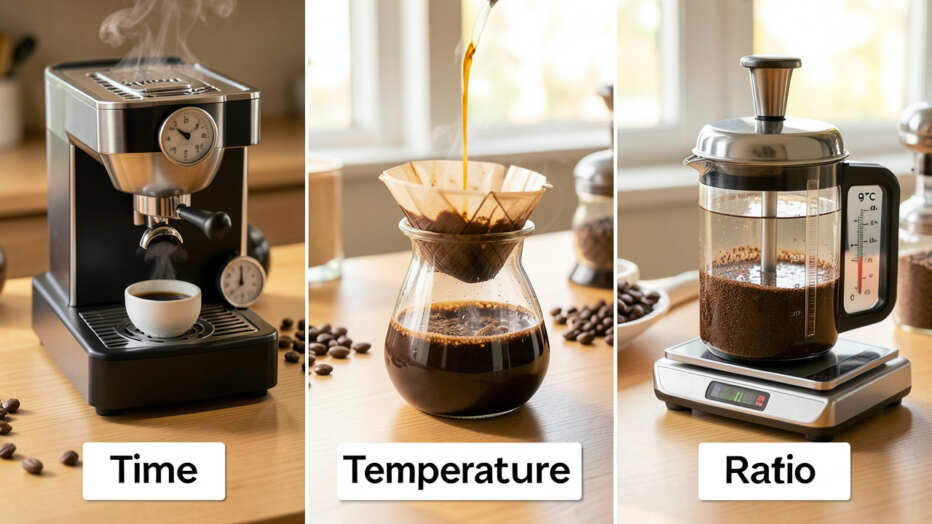
Coffee extraction relies on the precise coordination of time, temperature, and coffee-to-water ratio to achieve optimal flavor from ground beans. Brewing duration determines the extent of extraction, with water temperature influencing how quickly flavors are released. The coffee-to-water ratio sets the strength and balance, allowing adjustments to these three factors to fix common taste issues such as sourness or bitterness.
Making a great cup of coffee is more than just pouring hot water over grounds. It’s about getting the right flavors out of the beans. When you get this just right, your coffee tastes amazing.
If it’s off, it can taste sour or bitter. Understanding Coffee Extraction Explained: Time, Temperature And Ratio helps you control this. You’ll learn how these three things work together.
This knowledge lets you brew coffee exactly how you like it, every single time. We’ll look at how each part affects your brew and how to balance them.
Key Takeaways
- The time water spends with coffee grounds is vital for flavor.
- Water temperature greatly impacts how quickly and thoroughly flavors are released.
- The ratio of coffee to water determines the strength and balance of your brew.
- Adjusting these three factors can fix common coffee taste problems like sourness or bitterness.
- Mastering coffee extraction leads to consistently delicious coffee at home.
- Different brewing methods require different approaches to time, temperature, and ratio.
Why Coffee Extraction Matters for Taste
Coffee tastes the way it does because of what’s dissolved from the coffee beans into the water. This process is called extraction. When you brew coffee, you’re essentially dissolving soluble compounds from the coffee grounds.
These compounds include acids, sugars, and oils. Getting the right amount of these is key. Too little extraction, and the coffee tastes sour and weak.
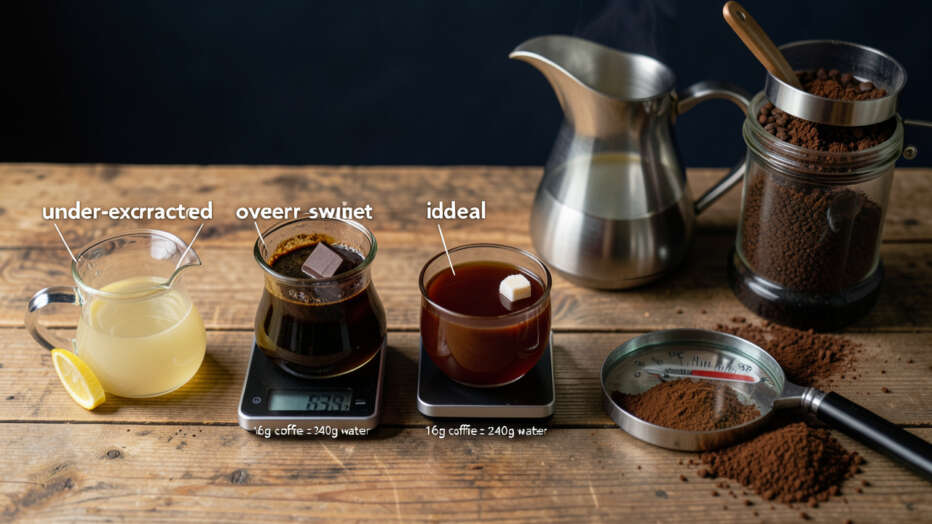
This is called under-extraction. Too much extraction, and the coffee tastes bitter and harsh. This is called over-extraction. Kitchentoolslab
If your coffee tastes sour, it is likely under-extracted; if bitter, over-extracted. Adjust your grind size or brew time to hit the sweet spot.
The sweet spot is perfect extraction, where you get a balanced, flavorful cup.
Understanding Coffee Extraction Explained: Time, Temperature And Ratio is your roadmap to achieving this perfect balance. It’s not about following a strict rule for every single coffee. It’s about knowing how to adjust.
You can fix a sour cup by brewing longer or hotter. You can fix a bitter cup by brewing shorter or cooler. This knowledge empowers you to make better coffee, no matter what beans or brewer you use.
The Role of Time in Coffee Extraction
Time is one of the most straightforward variables in coffee brewing. It’s the duration the water is in contact with the coffee grounds. Think of it like steeping tea.
If you steep tea for too short a time, it’s weak. If you steep it for too long, it can become bitter. Coffee is similar.
For most brewing methods, longer contact time means more flavor is extracted from the coffee grounds. This is why methods like French press, which have a longer steep time, can produce a fuller-bodied coffee. Espresso, on the other hand, uses very high pressure for a very short time (around 20-30 seconds) to extract flavor quickly.
First, consider your brewing method. A pour-over might take 2-4 minutes. An espresso shot is under a minute.
Finer coffee grounds have more surface area, extracting quickly and needing shorter brew times. Coarser grinds require longer contact to achieve full extraction.
A cold brew can take 12-24 hours. Each method has an ideal time range. If your coffee tastes sour, it might need more contact time.
Try increasing the brew time slightly. If it tastes bitter, it might have been in contact for too long. Try reducing the brew time.
Second, the grind size of your coffee beans affects how quickly extraction happens. Finer grinds have more surface area. This means they release flavors faster and require shorter brew times.
Coarser grinds have less surface area and need more time. So, if you’re tasting sourness, and your brew time seems right, you might need a finer grind to allow for more extraction in that time.
Next, when discussing Coffee Extraction Explained: Time, Temperature And Ratio, remember that time works with other factors. A very hot temperature can extract flavors quickly, meaning you might need less time. A cooler temperature extracts slower, possibly needing more time.
How Temperature Affects Coffee Flavor
Water temperature is a crucial element in coffee extraction. It dictates how efficiently soluble compounds are dissolved from the coffee grounds. Hotter water is a more powerful solvent.
It can break down and extract flavors much faster than cooler water.
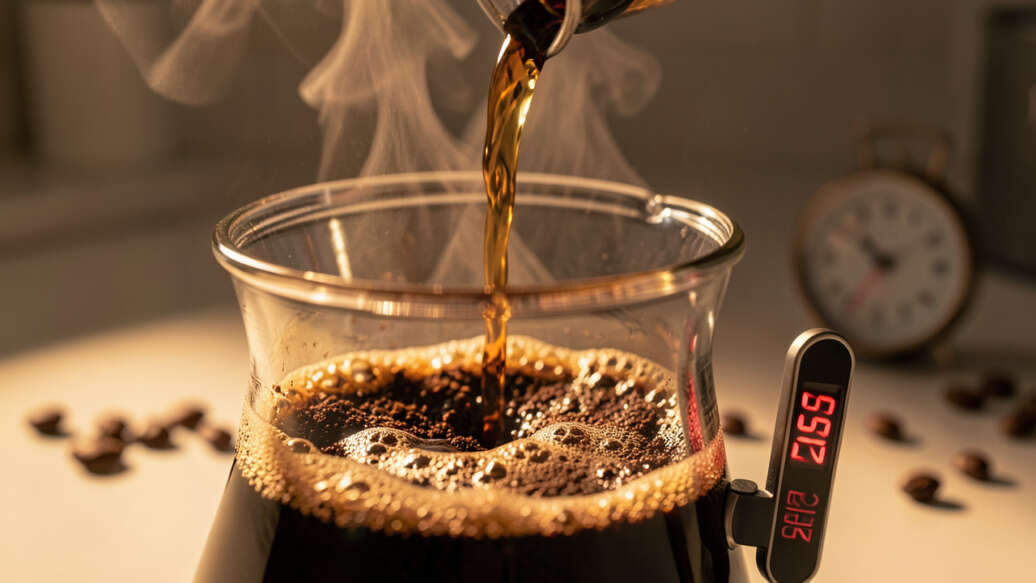
The Specialty Coffee Association (SCA) recommends a brewing temperature between 195°F and 205°F (90°C to 96°C). This range is considered ideal for most brewing methods. At this temperature, you get a good balance of acids, sugars, and oils extracted.
This leads to a sweet, complex, and aromatic cup.
If the water is too hot, say above 205°F (96°C), it can scald the coffee grounds. This leads to over-extraction. You’ll likely taste bitter, burnt, or acrid notes.
The delicate flavors can be destroyed. The coffee can taste harsh and unpleasant.
If the water is too cool, below 195°F (90°C), extraction will be slow and incomplete. This results in under-extraction. The coffee will taste sour, thin, and lacking in sweetness.
The right water temperature unlocks the ideal balance of acids, sugars, and oils for a flavorful cup.
You might notice a sharp, acidic bite without the body or flavor complexity you expect.
First, always heat your water to the right temperature. A good kettle with temperature control is very helpful. If you don’t have one, let boiling water sit for about 30-60 seconds before pouring.
This usually brings it into the ideal range.
Second, consider how temperature interacts with time. If you’re brewing a method that requires a longer contact time, like a pour-over, maintaining a stable temperature is important. If the temperature drops too much during the brew, you might end up under-extracting.
This is why insulated brewers or kettles are beneficial.
Next, for methods like espresso, temperature stability is even more critical. The machine’s boiler is designed to keep water at a precise temperature. Small fluctuations can significantly alter the extraction and the final taste of the shot.
Then, remember that even cold brew uses temperature, just at the opposite end of the spectrum. Cold water extracts compounds very slowly. This is why cold brew requires a much longer brewing time (hours instead of minutes).
It results in a smooth, low-acid coffee.
Understanding the impact of temperature is a key part of Coffee Extraction Explained: Time, Temperature And Ratio. It’s about using heat to unlock the best flavors without burning them away or leaving them behind.
The Importance of Coffee-to-Water Ratio
The ratio of coffee grounds to water is fundamental to the strength and balance of your coffee. It’s often expressed as a proportion, like 1:15. This means for every 1 gram of coffee, you use 15 grams (or milliliters) of water.
A common starting point for many brewing methods is a ratio between 1:15 and 1:18. For example, if you use 20 grams of coffee, you would use 300 to 360 grams of water (20 x 15 = 300, 20 x 18 = 360).
First, if you use too much coffee relative to water (a lower ratio, like 1:10), the coffee will be very strong. It might taste too intense, and if extraction isn’t perfect, it can lean towards bitterness. This is often called “over-dosing” on coffee.
Second, if you use too little coffee relative to water (a higher ratio, like 1:20), the coffee will be weaker. It might taste watery and lack body. If extraction is still off, it can taste sour because you’re not dissolving enough of the desirable compounds to balance the acids.
Start with a 1:16 coffee-to-water ratio for a balanced brew, then adjust by adding more coffee for extra strength or less for a lighter body.
Next, the ratio directly influences how much of the coffee’s potential flavor you extract. A correct ratio ensures you’re using enough water to dissolve the right amount of solubles from the grounds. It helps create a well-rounded flavor profile.
Then, think about how ratio interacts with time and temperature. If you have a lot of coffee and not enough water, extraction might be fast and incomplete, leading to sourness. If you have too much water for a small amount of coffee, you might over-extract, leading to bitterness, because the water has more time and capacity to pull out everything.
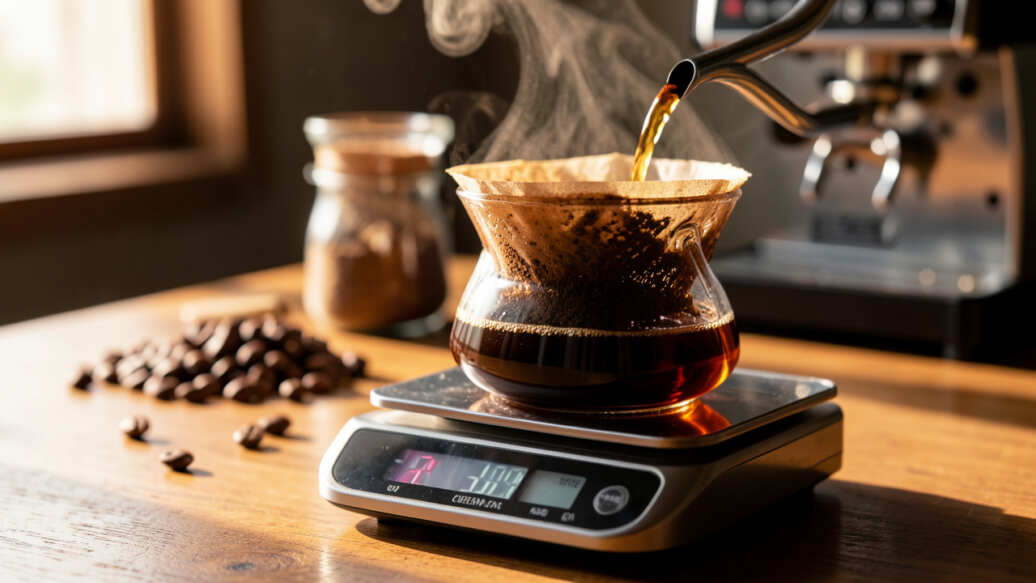
Finally, using a kitchen scale is highly recommended for consistent results. Measuring by volume (scoops) can be inaccurate because different coffee beans and roasts have different densities. Weighing both your coffee and your water ensures you can replicate your favorite brews and make precise adjustments.
Mastering the ratio is a crucial part of Coffee Extraction Explained: Time, Temperature And Ratio. It’s about setting the stage for the other variables to work their magic.
Comparing Brewing Methods: Time, Temperature, and Ratio
Different brewing methods have different characteristics. These differences mean they require different approaches to time, temperature, and ratio to achieve optimal extraction. Understanding these variations helps you choose the right method for the taste you want.
As you can see from the table, the variables for Coffee Extraction Explained: Time, Temperature And Ratio vary significantly. Espresso uses a very short time but high pressure. French press uses a longer time with immersion.
Cold brew is an extreme example of long time and low temperature.
The ratio also changes. Espresso uses a much tighter ratio for concentration. Cold brew often starts with a concentrated ratio, which is then diluted with water or milk.
Avoid using the same brew parameters across different methods—espresso requires a fine grind and short time, while French press demands a coarse grind and long steep. Incorrect parameters lead to poor extraction.
This allows for control over the final strength.
First, when you try a new brewing method, start with the recommended settings for time, temperature, and ratio. These are usually well-tested starting points.
Second, don’t be afraid to experiment. If your pour-over tastes a bit sour, try a slightly finer grind or a bit more contact time. If your French press tastes bitter, try a coarser grind or a slightly shorter brew time.
Next, remember that the quality of your coffee beans and your roast level also play a role. Lighter roasts might benefit from slightly higher temperatures or longer extraction times to bring out their sweetness. Darker roasts can extract very quickly and might need slightly lower temperatures or shorter times to avoid bitterness.
Finally, the goal is always to find the perfect balance for your palate and your specific beans. The interplay of time, temperature, and ratio is what makes Coffee Extraction Explained: Time, Temperature And Ratio so fascinating and rewarding.
Troubleshooting Common Coffee Taste Issues
Many common coffee taste problems can be directly linked to issues with extraction, specifically how time, temperature, and ratio were managed. By understanding these connections, you can become a coffee detective and fix your brews.
Sour Coffee
Sourness in coffee is usually a sign of under-extraction. This means not enough of the desirable soluble compounds were dissolved from the grounds into the water. The acids are often the first compounds to be extracted.
If the brew stops too soon or isn’t hot enough, you’re left with a dominant sourness.
Sour coffee indicates under-extraction—try a finer grind or hotter water. Bitter coffee is over-extracted—use a coarser grind or shorter brew time.
- Time: Your brew time might be too short. Try increasing it by 15-30 seconds.
- Temperature: Your water might be too cool. Ensure it’s within the 195-205°F (90-96°C) range.
- Grind Size: If time and temperature are correct, your grind might be too coarse. Try grinding finer to increase surface area and speed up extraction.
- Ratio: You might be using too much water for the amount of coffee. Try a tighter ratio (more coffee to water).
Bitter Coffee
Bitterness is typically a sign of over-extraction. This means too many soluble compounds, including less desirable bitter compounds, were dissolved. This happens when coffee grounds are in contact with water for too long, at too high a temperature, or when the grind is too fine.
- Time: Your brew time might be too long. Try reducing it by 15-30 seconds.
- Temperature: Your water might be too hot. Ensure it’s not exceeding 205°F (96°C).
- Grind Size: If time and temperature are correct, your grind might be too fine. Try grinding coarser to slow down extraction.
- Ratio: You might be using too little coffee for the amount of water. Try a looser ratio (less coffee to water).
Weak or Watery Coffee
This can be a combination of under-extraction and an incorrect ratio. It lacks body and flavor depth.
- Ratio: This is often the main culprit. Try using more coffee relative to water (e.g., move from 1:17 to 1:15).
- Time/Temperature: Ensure you are extracting enough. If the ratio is right, but it’s still weak, you might need to increase brew time or temperature slightly.
Bland or Flat Coffee
This can happen when extraction is just okay, but not great. You’re not getting the full spectrum of flavors.
- Ratio: Ensure you’re not using too much water. A slightly tighter ratio can boost flavor.
- Grind Size: Experiment with a slightly finer grind to unlock more complexity.
- Bean Quality/Roast: Sometimes, the beans themselves might be the issue, or the roast is too light or too dark for your preference.
By systematically adjusting one variable at a time – time, temperature, or ratio – you can troubleshoot and improve your coffee. This hands-on approach is the best way to truly understand Coffee Extraction Explained: Time, Temperature And Ratio.
Frequently Asked Questions
What is the ideal water temperature for coffee extraction?
The ideal temperature range for coffee extraction is generally between 195°F and 205°F (90°C to 96°C). This range allows for efficient dissolving of desirable flavors without scalding the grounds.
How does coffee grind size affect extraction time?
Finer coffee grinds have more surface area, leading to faster extraction and requiring shorter brew times. Coarser grinds extract slower and need longer brew times.
What is the best coffee-to-water ratio for beginners?
A good starting point for beginners is a ratio of 1:15 to 1:17 (1 gram of coffee to 15-17 grams of water). Using a scale is recommended for accuracy.
Can I fix sour coffee by changing only the time?
Yes, if your coffee tastes sour, it’s likely under-extracted. Increasing the brew time is one of the most effective ways to improve extraction and reduce sourness.
What happens if my water temperature is too high for coffee extraction?
Water that is too hot (above 205°F or 96°C) can scald the coffee grounds, leading to over-extraction and a bitter, harsh taste.
Does the ratio of coffee to water impact the bitterness of my coffee?
Yes, an incorrect ratio can contribute to bitterness. Using too little coffee (a very high ratio) can lead to over-extraction and bitterness if the brew time is also long. A very low ratio (too much coffee) can also be intense and bitter if not managed well.
Is Coffee Extraction Explained: Time, Temperature And Ratio different for hot and cold coffee?
Absolutely. Cold brew uses cold water and a much longer time to extract flavors, resulting in a different flavor profile than hot brewing methods which rely on higher temperatures for faster extraction.
Final Thoughts
Mastering coffee extraction means understanding how time, temperature, and ratio work together. By adjusting these three key elements, you can transform your home brewing. Aim for a balanced taste by avoiding sourness and bitterness.
Experiment with your settings to find what makes your favorite beans shine.