
TITLE: Air Fryer vs Oven Energy Use: Real Numbers
Many home cooks wonder if their air fryer really saves them money on their electricity bill compared to their regular oven. It’s a smart question to ask, especially with rising energy costs. Understanding the difference in power consumption can help you make better choices for your kitchen and your wallet.
This guide breaks down the Air Fryer Energy Usage vs Oven: Real Numbers so you can see the savings for yourself. We’ll look at how much each appliance uses and when one is a clear winner for efficiency.
Key Takeaways
- Air fryers generally use less energy than conventional ovens for smaller cooking tasks.
- Ovens consume more power due to their larger size and longer preheating times.
- The type of food and cooking time significantly impacts the energy used by both appliances.
- Using an air fryer for quick snacks or reheating can lead to noticeable electricity savings.
- For large meals, a conventional oven might be more energy-efficient per serving than multiple air fryer batches.
- Preheating is a major factor in oven energy consumption, which air fryers often minimize.
How Much Power Do These Appliances Use?
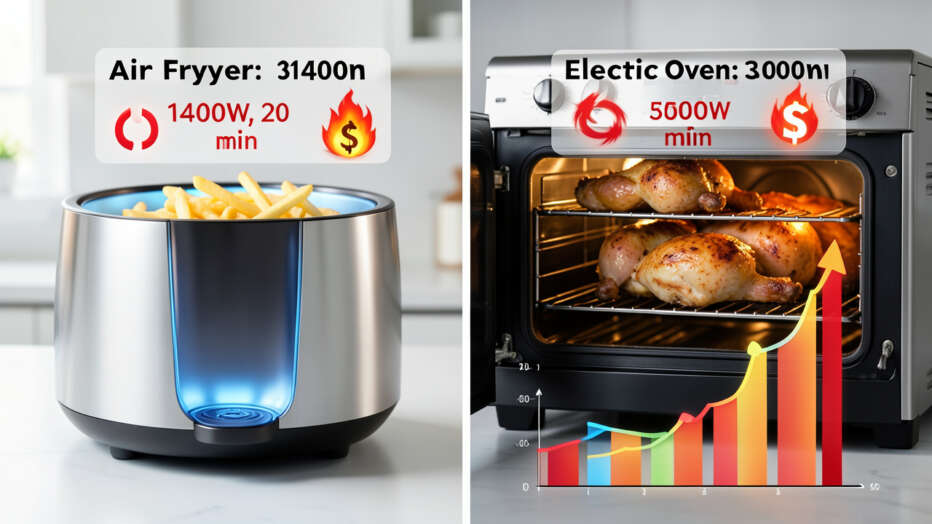
When we talk about how much electricity an appliance uses, we often look at its wattage. Wattage tells you how much power an appliance needs to run. Think of it like how much gas a car uses per mile.
Higher wattage means it uses more electricity when it’s on.
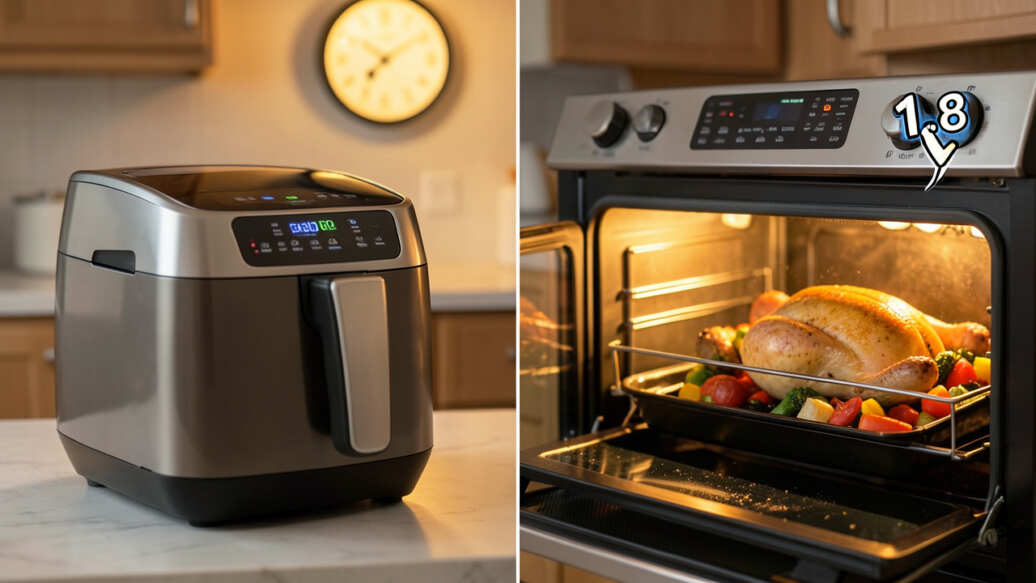
A typical oven, especially a full-sized one, can have a powerful heating element. This is needed to heat up a large space. Many ovens range from 2,000 to 5,000 watts.
This is a lot of power, especially when you consider how long you might preheat it or cook a meal.
Air fryers, on the other hand, are much smaller. They are designed to cook food quickly in a confined space. Most air fryers have wattages between 1,000 and 1,800 watts.
This seems high, but because they are used for shorter periods and heat a smaller area, their total energy use can be much lower.
Air Fryer Energy Usage vs Oven: Real Numbers
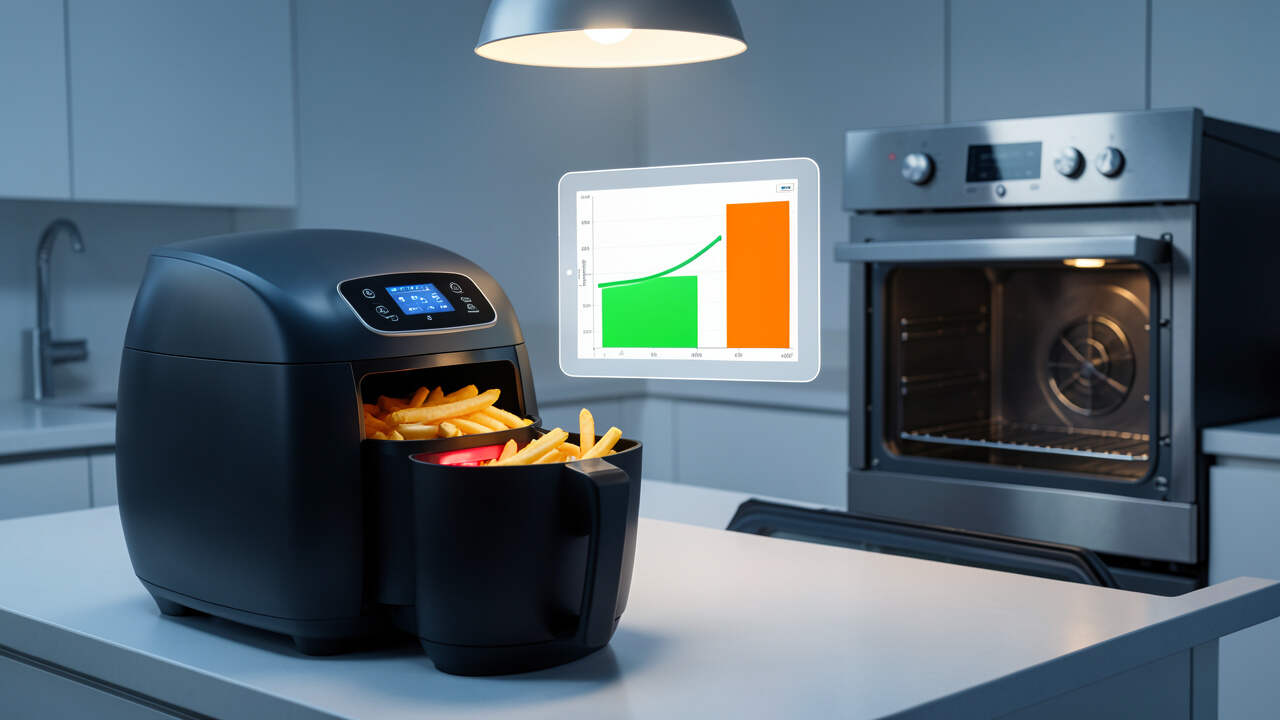
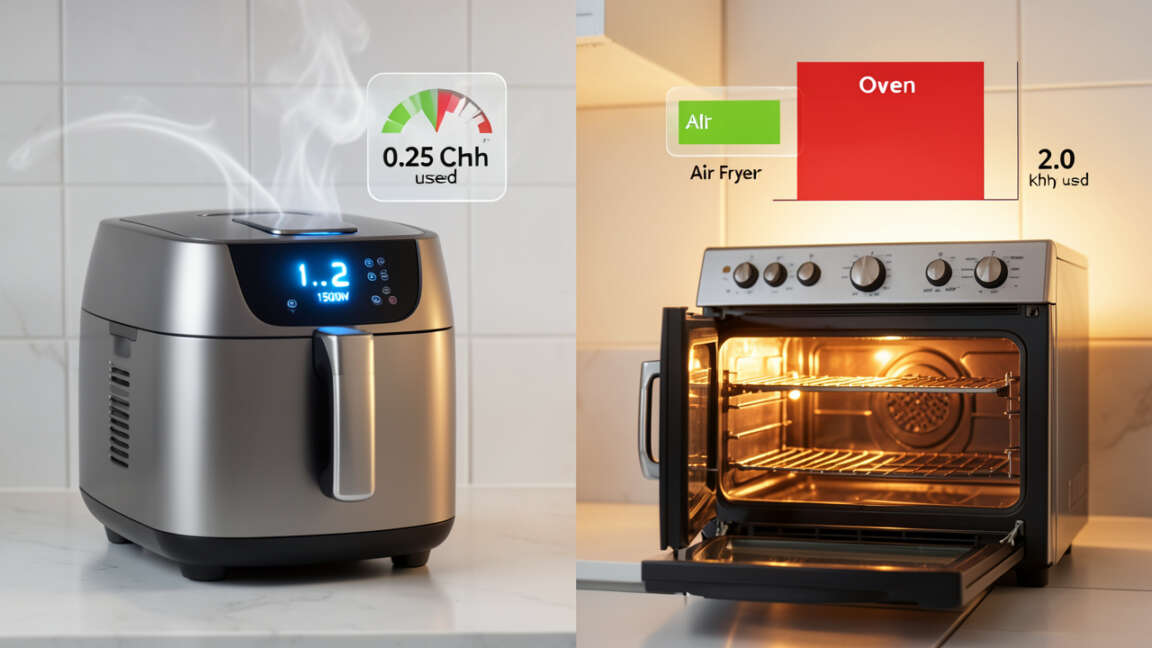
Let’s get down to the Air Fryer Energy Usage vs Oven: Real Numbers. It’s not just about wattage; it’s about how long that wattage is used. This is where the real savings come in.
To compare them fairly, we need to look at typical cooking scenarios.
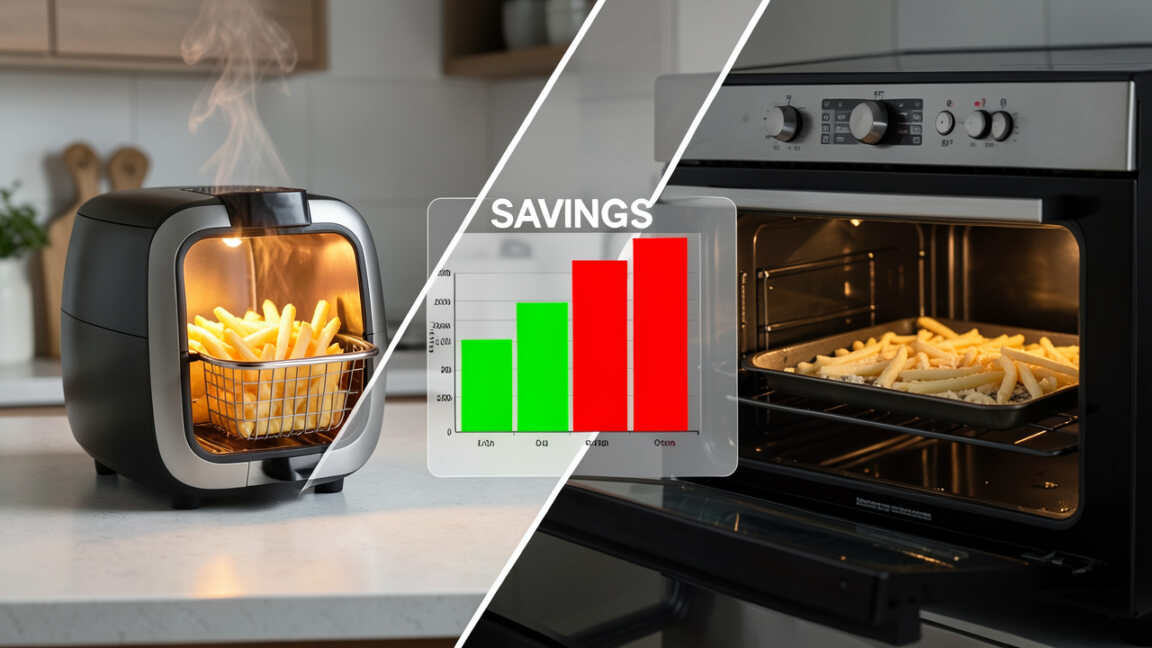
Consider cooking a batch of fries. A conventional oven might need 10-15 minutes to preheat. Then, the fries themselves might cook for 20-30 minutes.
During this entire time, the oven is drawing power, often at its maximum wattage.
An air fryer, however, preheats very quickly, often in 3-5 minutes. The fries might cook in 10-15 minutes. Because the cooking time is shorter and the preheat is faster, the total energy consumed is often much less.
This is a key reason why many people find air fryers to be more energy-efficient for everyday tasks.
This table gives you a snapshot. The actual Air Fryer Energy Usage vs Oven: Real Numbers can vary. But generally, for small portions, the air fryer wins on energy savings.
When Does the Oven Make More Sense?
While air fryers are great for small jobs, they aren’t always the best choice. If you’re cooking for a large family or making a big roast, an oven is usually more practical. Trying to cook a large meal in an air fryer might mean doing several batches.
This could actually end up using more energy overall than one cook in a larger oven.
Think about baking a cake or cookies for a party. An oven is designed for this. It heats evenly and can handle large pans.
While some larger air fryers can bake, they are limited by their size. For these types of tasks, the oven is often the more efficient and effective tool.
Another factor is cooking time. If a recipe takes a very long time, like a slow-cooked stew that needs hours, an oven might be more efficient than running an air fryer for that duration. However, most recipes suitable for air fryers are quick-cooking.
Factors Influencing Energy Consumption
Several things affect how much energy your appliances use. It’s not just the appliance itself. The food you cook and how you cook it play a big role.
Understanding these factors helps you get a clearer picture of Air Fryer Energy Usage vs Oven: Real Numbers.
Food Type and Quantity
Cooking dense foods, like a whole chicken, requires more energy than cooking lighter items, like vegetables. Similarly, cooking a larger quantity of food means the appliance needs to work harder and longer, using more electricity.
An air fryer excels with smaller, single servings or snacks. Think chicken tenders, small portions of vegetables, or reheating leftovers. For these, it heats up fast and cooks quickly.
An oven might take longer to heat up for just a few chicken tenders, making it less efficient for that specific task.
Preheating
Preheating is a huge energy drain, especially for ovens. The appliance uses a lot of power just to reach the desired temperature. Once it’s hot, it uses less power to maintain that temperature while cooking.
Air fryers are designed for rapid heating. They have smaller fans and heating elements. This means they get to temperature much faster than an oven.
This significantly cuts down on the energy used before the actual cooking begins.
Cooking Temperature and Time
Higher temperatures and longer cooking times naturally mean more energy use. If you’re cooking something at 400°F for 30 minutes in an oven, it will use more energy than cooking something at 375°F for 15 minutes in an air fryer.
This is why the Air Fryer Energy Usage vs Oven: Real Numbers often favor the air fryer for common cooking needs. Many popular air fryer foods cook quickly at moderate temperatures.
Appliance Efficiency
Not all appliances are created equal. Newer models tend to be more energy-efficient than older ones. An energy-efficient oven might use less power than an older, less efficient air fryer, and vice versa.
Look for Energy Star ratings if you’re buying new appliances.
Calculating Real-World Savings
To really understand the savings, let’s look at a hypothetical scenario. Suppose electricity costs $0.15 per kilowatt-hour (kWh). A kilowatt is 1,000 watts.
Scenario 1: Cooking Fries
- Oven: 3,000 watts (preheat + cook) for 40 minutes (0.67 hours). Total energy: 3 kW 0.67 hours = 2.01 kWh. Cost: 2.01 kWh $0.15/kWh = $0.30.
- Air Fryer: 1,500 watts (preheat + cook) for 20 minutes (0.33 hours). Total energy: 1.5 kW 0.33 hours = 0.495 kWh. Cost: 0.495 kWh $0.15/kWh = $0.07.
In this example, using the air fryer for fries saves about $0.23 per cooking session. If you do this a few times a week, the savings add up.
Scenario 2: Baking Cookies
- Oven: 3,000 watts (preheat + cook) for 30 minutes (0.5 hours). Total energy: 3 kW 0.5 hours = 1.5 kWh. Cost: 1.5 kWh $0.15/kWh = $0.23.
- Air Fryer (multiple batches): Let’s say you need 3 batches. Each batch uses 1,500 watts for 15 minutes (0.25 hours). Total energy per batch: 1.5 kW 0.25 hours = 0.375 kWh. For 3 batches: 3 0.375 kWh = 1.125 kWh. Cost: 1.125 kWh * $0.15/kWh = $0.17.
Here, the air fryer might seem cheaper. However, this assumes your oven is less efficient or you’re cooking a small amount. If you bake a lot of cookies for a party, one oven cycle is usually more efficient per cookie than multiple air fryer cycles.
These calculations highlight the importance of context when looking at Air Fryer Energy Usage vs Oven: Real Numbers. The size of the meal and the appliance’s capacity are critical.
Tips for Maximizing Energy Efficiency
Whether you use an air fryer or an oven, you can cook more efficiently. Small changes can lead to bigger savings over time. Here are some practical tips:
- First, always preheat your appliance only when necessary. Air fryers often don’t need much preheating. For ovens, if the recipe doesn’t strictly require it, you might get away with skipping it, especially for denser items.
- Second, use the right size appliance for the job. Don’t heat up a large oven for a single chicken breast. Use your air fryer or toaster oven instead.
- Next, avoid opening the oven door too often. Every time you open it, you lose heat. This makes the oven work harder to get back to temperature.
- Then, cook food in batches if needed, but consider the overall time. If you can cook everything in one oven cycle, it’s usually better than multiple air fryer cycles.
- Finally, keep your appliances clean. A clean oven and air fryer basket can help them heat more evenly and efficiently.
Air Fryer Energy Usage vs Oven: Real Numbers in Summary
When comparing Air Fryer Energy Usage vs Oven: Real Numbers, the air fryer generally uses less electricity for smaller portions and quick cooking tasks. Its rapid preheating and shorter cooking times make it a more energy-efficient choice for snacks, reheating, and meals for one or two people. Conventional ovens, while more powerful, are better suited for larger meals, baking, and batch cooking due to their capacity and even heat distribution.
Frequently Asked Questions
What is the biggest factor in oven energy use?
The biggest factor is preheating. Ovens use a significant amount of energy just to reach the desired temperature, especially for larger ovens.
Can an air fryer really save me money on my electricity bill?
Yes, for smaller cooking tasks. If you frequently use your air fryer for things like reheating leftovers or cooking snacks instead of your oven, you can see noticeable savings on your energy bill.
Is it more energy-efficient to use an air fryer or a toaster oven?
Both are generally more energy-efficient than a full-sized oven for small jobs. Their energy use is often quite similar, depending on the specific models and tasks.
When is an oven more energy-efficient than an air fryer?
An oven is usually more energy-efficient when cooking large meals, baking, or when you need to cook a large quantity of food at once. It avoids the need for multiple batches that an air fryer might require.
How does the wattage of an air fryer compare to an oven?
Air fryers typically have lower wattages (1,000-1,800 watts) than conventional ovens (2,000-5,000 watts), but their shorter run times often lead to lower overall energy consumption for typical tasks.
Does the Air Fryer Energy Usage vs Oven: Real Numbers change with different types of food?
Yes, denser foods or foods that require longer cooking times will use more energy in either appliance, impacting the overall comparison of Air Fryer Energy Usage vs Oven: Real Numbers.
Final Thoughts
Choosing between your air fryer and oven depends on what you’re cooking. For quick meals and snacks, the air fryer is often the energy-saving champion. For larger feasts or baking, your oven remains the reliable choice.
Using both wisely helps you save energy and money.